Water service line inventory survey
Per federal U.S. Environmental Protection Agency (EPA) drinking water regulations, City of Dover staff are inventorying all water service lines connected to its public drinking water system to ensure there are no lead is in use within the system. Specifically, the city is tasked with documenting all service line material – public and private sides.
Why is the city creating this inventory?
- To ensure no lead is in use within the City of Dover’s public drinking water system;
- To comply with federal regulations.
What is a water service line?
It’s the pipe delivering drinking water from the water main to homes, businesses and schools. It includes a shutoff valve known as a curbstop at the property line that delineates maintenance and upkeep responsibilities.
Who owns the water service line?
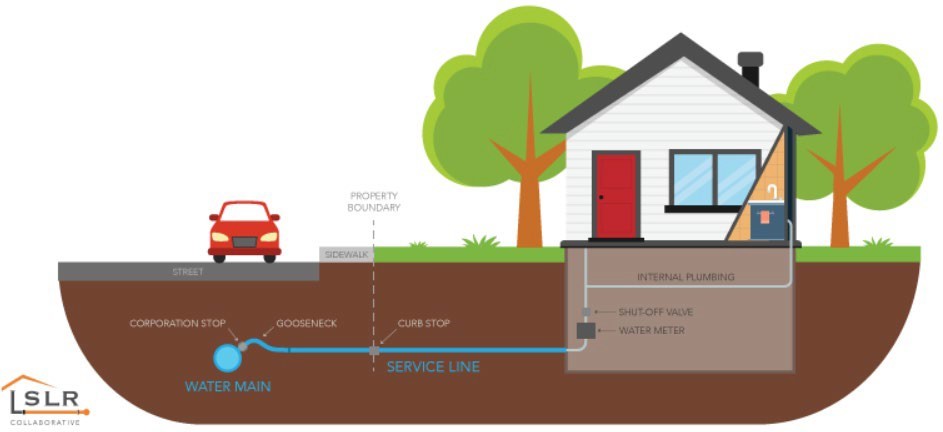 Property owners own and maintain the service line section on their property. Ownership of the curbstop and service line between the curbstop and water main depends on the ownership of the water main.
- Publicly-owned water mains: On publicly owned or maintained streets, the city owns and maintains the main, curb stop, and service line to the property line.
- Privately-owned water mains: The city does not own or maintain any part of these water mains and service lines, which are found in most private subdivisions governed by a homeowner’s association (HOA). Service line ownership depends on the HOA contract.
Why should I be concerned about lead?
Lead is a toxin that poses serious health risks to all people, but young children, infants and developing fetuses are especially vulnerable to lead exposure. Lead service lines and plumbing materials (including solder, fixtures, and faucets) are the most common lead sources in a home’s drinking water. Galvanized iron or steel pipes can pose risks if ever connected downstream of a lead service line, as lead can attach to the inner surface of galvanized steel and be released into drinking water over time. Service lines made of galvanized iron or steel that are (or were previously) downstream of lead service lines (LSL) are classified as a galvanized requiring replacement (GRR) service line.
Water service line materials
Lead pipes and lead solder were banned countrywide in 1986 by the U.S. Safe Water Drinking Act, and the 1991 EPA Lead and Copper Rule. However, Dover and many other communities across the country already phased out lead decades earlier.
When Dover Water Works was established in 1888, galvanized steel pipes were the standard service line material. Due to its rigidness, pliable lead pipe “goosenecks” connected the galvanized service lines to the main, allowing the seasonal expansion/contraction ground movement. The city believes – though not certain – this practice ended by the mid-20th century, as copper became more available. Since then, the city has utilized copper or drinking water-grade plastic for service lines.
For decades the City of Dover has proactively replaced any known lead material used in service lines, either through the renewing of services in street reconstruction projects or from water leaks, as galvanized services have a propensity to leak. However, there may be instances where lead still exists, often in older homes.
What is my water system required to do now?
- By Nov. 1, 2025: All public water systems countrywide must submit an inventory of the service lines to the appropriate state agency; in Dover’s case, it’s the N.H. Department of Environmental Services (NHDES). Even if all water lines in the drinking water system are non-lead, water systems must still confirm their materials and submit the inventory.
- By Dec. 1, 2025: All public water systems must notify all properties with service lines that contain lead or potentially contain lead. Service lines are considered potentially lead if their material is listed as unknown in the inventory. The city sent notifications by mail to all affected properties.
The City of Dover encourages property owners to identify their service line material, especially those where a galvanized service line is still in use.
Replacement of public water service lines
The City of Dover is working to identify/replace all public portions water service lines, which typically runs from the water main to the curb stop/shutoff near the right-of-way.
The city is responsible for all costs associated with the replacement of the publicly owned portion of water service lines, including all costs associated with the restoration of any property disturbance.
The city will coordinate the replacement of the city portion of your service line with the property owner and and the city’s on-call contractor. Water service will be shut off for the duration of the replacement, which typically takes 4-8 hours.
After the city portion of the water service line is replaced, per Environmental Protection Agency (EPA) and New Hampshire Department of Environmental Services (NHDES) guidelines, the city will provide a new Brita Water Pitcher with an Elite Filter cartridge for the water customer's use. The Elite filters are tested and rated to remove 99% of lead. Upon request, the city will provide additional filters for up to 6-months of usage after replacement of your water service line. The city will also provide a follow up water test kit 3 to 6 months after replacement.
The city has a corrosion control program to help prevent lead or galvanized pipes from corroding and contaminating drinking water. Though this greatly reduces the potential for lead to leach into drinking water, we recommend that properties with a lead or galvanized service line or lead in their household plumbing to run their tap on the cold setting for at least 1 minute prior to filing your Brita filter and/or using any water for drinking or cooking.
Funding
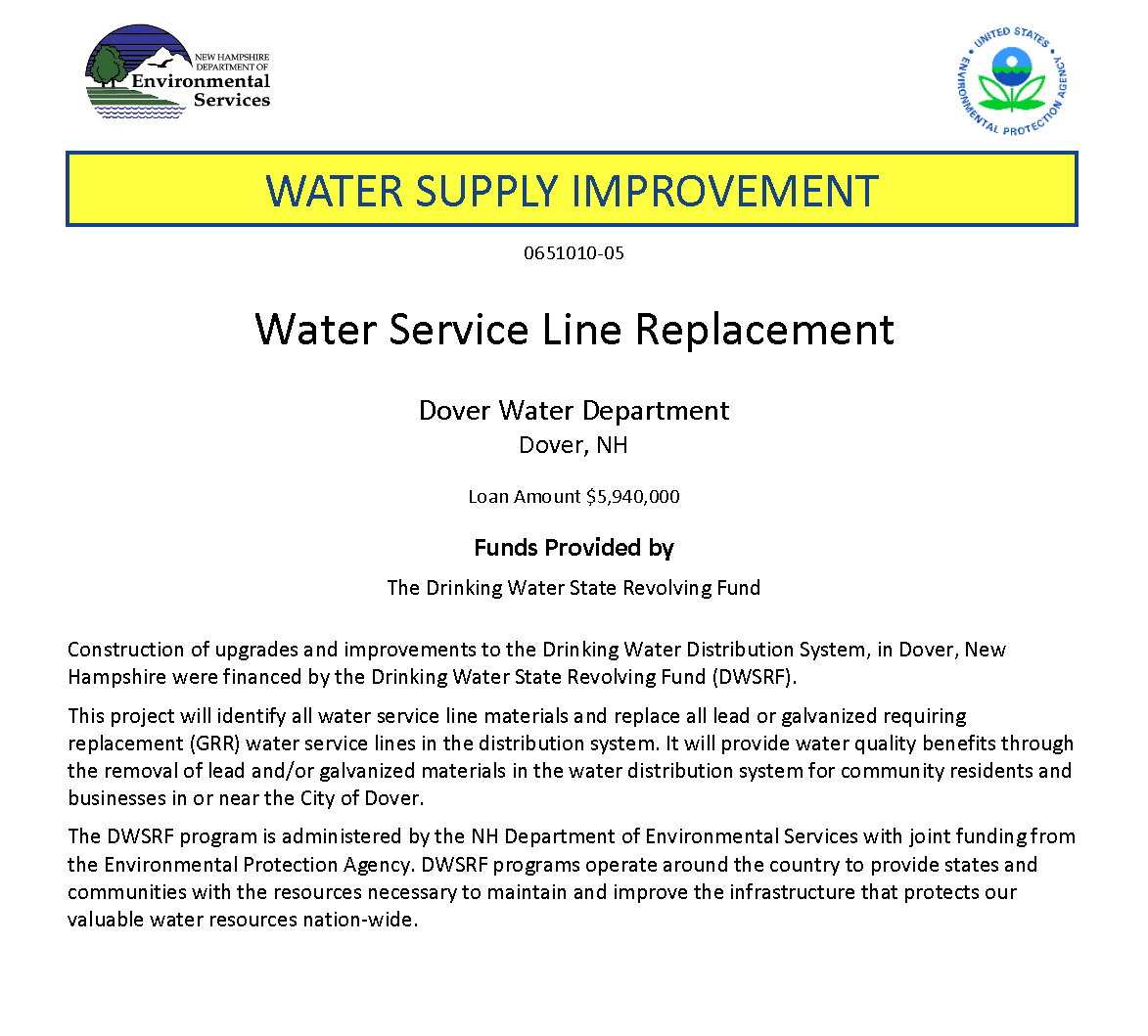
Construction of upgrades and improvements to Dover's Drinking Water Distribution System are being financed by the Drinking Water State Revolving Fund (DWSRF). The loan amount is $5,940,000. The project number is 0651010-05.
This project will identify all water service line materials and replace all lead or galvanized requiring replacement (GRR) water service lines in the distribution system. It will provide water quality benefits through the removal of lead and/or galvanized materials in the water distribution system for community residents and businesses in or near the City of Dover.
The DWSRF program is administered by the NH Department of Environmental Services with joint funding from the Environmental Protection Agency. DWSRF programs operate around the country to provide states and communities with the resources necessary to maintain and improve the infrastructure that protects our valuable water resources nation-wide.